
Showing posts with label Pearl Harbor. Show all posts

Sunday, December 13, 2015

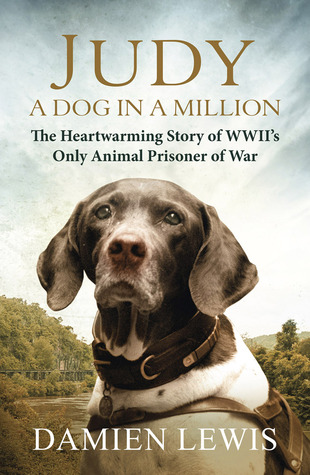
Judy: A Dog In A Million by Damien Lewis


I requested this book after reading about Rags (From Stray Dog to WWI Hero), I decided I wanted to read it from the title alone. Between getting a copy and starting it, I had a few other books on my list to read. When I got to this book, I actually got a little apprehensive. Rags made me sad, and I began to contemplate whether I was emotionally alright with reading this book. I pretty much have a breakdown whenever an animal is harmed on TV or in a movie or a book. But I decided it must be a good story and even though the dog most likely dies (not a spoiler, this took place during WWII), I wanted to read it.

First off, I must confess that I had no idea about the POW camps in Asian during WWII. In short, all the allied forces and Americans in the area were rounded up and made to build railways through impossible terrains.

Judy was chosen as a gunboat mascot from a kennel in Shanghai. While she was an excellent mascot, and saved her shipmates lots of trouble, Judy would soon do so much more.

Judy was inspirational to many people in the far east POW camps during WWII. More people knew of Judy than they did the hell railroad that the POWs were forced to build, and many former POWs say that their pets in the camps kept them alive, by giving them a little normalcy and something to stay alive to care for.

I fell in love with Judy's humans, as well, when Olivar and Wuley saved her and Tank made a fool of himself trying to train her.

I also learned a lot through this book. I am an animal lover (yes, I am a cat AND dog person!) and a dog owner. I thought I knew a lot about dogs, but this book gave me further insight. For example, I was unaware that dogs could pick up scent through their whiskers, and their "superior smelling abilities are intensified by a scent detecting organ, the voremonasal, situated in the roof of their moth, which is completely lacking in humans, and one that we, as yet, little understand."

I was super impressed with how smart Judy was! She learned to communicate with her many humans in a way to get what she wanted, and later what was needed to save their lives. I cannot believe how amazingly intelligent and brave she was.

She chose her own masters, and protected her family with all she had (and then some).

Even when struggling for her own life, she used all the strength she could must to rescue everyone she could. And her story is a prime example of the strength in a dog's loyalty. She was loyal to her masters and her family above all else. However, that loyalty was not one-sided, and had her human family not risked their own lives, Judy certainly would not have made it through the POW camps.

While I like that the author included the inscription on Judy's tombstone at the end of the book, I thought that more could be said to wrap up the end of the book.

Nonetheless, this book was excellent! With more dogs like Rags and Judy, and more people like their humans, the world would be a much better place.

I received a free copy of this book from the publishers, via NetGalley, in exchange for an honest review.


Tuesday, November 10, 2015

Gasa Gasa Girl Goes to Camp: A Nisei Youth Behind A World War II Fence by Lily Yuriko Nakai Havey, Cherstin Lyon


For those of us who were not born at the time of the bombing of Pearl Harbor, the Japanese, and the Asian people as a whole in the US, were treated like anyone that looked Arab was treated after 9/11. Gasa Gasa Girl goes to Camp is the story of one girl’s experience [n the Japanese camps after the bombing of Pearl Harbor. When her family first departed for the camp, Yuriko thought her family would go camping in the woods in a tent, just as the all-white Girl Scouts got to do every summer. The reality of the ugly, black buildings upon their arrival was a shock to the young girl. She thought the camping trip would be the beginning of a new relationship with her father, instead, he turned into an “elusive shadow” that summer, a stranger to his family.

Contains spoilers: 

Her family went from living in “Hollywood, a poor section, to be sure, but Hollywood,” to living “in a barrack at a racetrack.” Her father retreated into a bottle. The rest of the family “internalized the principles of gaman and shikatanagonai…teaming not to verbalize fears, frustration and conflict,” and gambano, meaning “take whatever life brings.”

“Stoic and principled Japanese were supposed to handle unbearable situations in this matter.” Her parents both had terrible childhoods and now their daughter was experiencing, not at the hands of her parents, “but at the hands of the government that promised them freedom and a better life.” Yuriko was terrified of even using the bathroom at night for the fear of being shot by American guards.
Yuriko did not identify with the Japanese that bombed Pearl Harbor. “The Japanese - these other war mongering Japanese – had deprived me of those things. However, I sensed that somehow OUR American government, MY American government was also responsible. It had made the decision to rip thousands of people from their homes and place them in isolated camps.

Yuriko spent three years in the camp, growing and maturing in them. When it was time to leave, she couldn’t remember much about “real life.” She wasn’t sure if it would be better than the camp and was unsure about the unfamiliar and unknown.

Lately, I have been reading a lot about the Holocaust and individuals’ experiences in the concentration camps. So, when I saw this book on NetGalley, it peaked my interests. I had not read any accounts of individual experiences in the Japanese camps and didn’t really know much about them or about how life was for Asians in American during the time after the Pearl Harbor bombing. This book opened my eyes to the similarities between how people reacted after 9/11 towards anyone that looked Arab or Muslim.


I just finished a Multicultural Diversity class, and many of the themes in this book fit along with things we addressed in class. In fact, I am going to suggest this book to my teacher. It gives you great insight into the life of Asians during that time, and I think it is important for people to read things like this. When individuals do something bad, it does not mean that their entire race is bad. This is something that speaks to our society today just as much as it did during Yuriko’s story.

I received a copy of this book for free from the publishers via NetGalley in exchange for an honest review.