Wednesday, February 17, 2016

Complaint Restraint February Tumblr

Check out their new Tumblr!

We decided to open a simple Tumblr blog and invite all of you to share your own experiences with Complaint Restraint.

Congratulations! You’ve already made it through more than half of Complaint Restraint February! Some of you write us that it’s going really well, others are fighting a bit harder not to complain.

But as we’ve always said, this is about the process, not any specific outcome we’re aiming for. What I notice each year during February is that while this is about myself, it’s also about the people around me, and I learn a lot about people close to me each February, too. Who’s a more negative person, who has a more positive effect on their friends? How do others deal with actually problematic aspects of their life?

So when Naomi, a participant from Vancouver, Canada, asked us about setting up a place for all of you to share your experiences, we figured why not? Here’s her email:
I have been doing my best not to complain about things I have no control over to change. But what I find interesting is being aware of others complaining about little things and wasting their energy on that. I wish with this challenge you have a forum that posted everyone’s comments so we could be changed and know how everyone else is doing thru this.
Head over to the Tumblr to share your thoughts and views on Complaint Restraint. How is it working for you? What have you learned since starting out? We’re looking forward to all of your thoughts!

Also, if you by chance know BeyoncĂ©, let her know that we’d love to have her participate next year ;)

Have a great week,
Thierry & Pieter

Tuesday, February 16, 2016

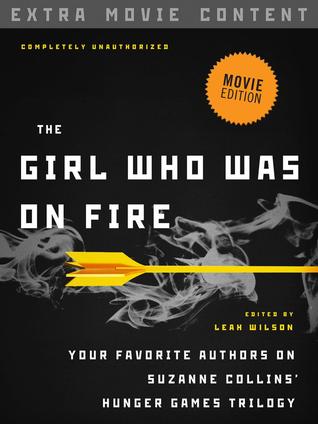
The Girl Who was on Fire - Movie Edition by Leah Wilson

I was excited when I saw this as an option on NetGalley, especially after finishing the Panem Companion. Not only did it help me dig deeper into The Huger Games series, but it also caused me to take a deeper look into all of the books I read, especially YA books, whether it be taking note of their cultural norms, gender roles, other societal structers, or more depth to the characters.

This is not one book, but a series of essays written by popular YA authors about The Hunger Games series. I love that, having read the Panem Companion, I has a background knowledge of Susan Collins' intentions and meaning behind THG, but this book is not just a repeat of that. This book focuses on the readers'/watchers' views, opinions and feelings about THG.

One of the first things that stuck out to me was focusing on media truths/lied. At first, Katniss has a hard time lying at all about her and Peeta's relationship, but by Mockingjay, she betrays even the readers with ehr intention to create a new Hunger Games and kills Coin instead of Snow. With this, Sarah Rees Brennan points out, in the first essay, Peeta's position in Mockingjay. His perception has been so altered that he must rely on other telling him what is "Real or not real?"

His position is horrifying, and yet it is just a magnified version of everyone's position in THG - of our own positions as consumers of entertainment that pretends to reflect reality.

I am very glad that Jennifer Lynn Barns focused on the love triangle angle. I have also become tired with the endless triangles.

I AM TEAM KATNISS!

THG trilogy has less to do with who Katniss ends up with and more to do with who she is - because sometimes, in books and in life, it's not about romance.

THANK YOU JLB!

I also didn't like how I saw so much Team Gale and Team Peeta. These books were not, at their core, about love. They were about society, war and rebuilding a better society. Katniss was not all swoony, like most YA heroines, today. (Thank God!) She stick to what is important in a time of crisis, which is not who she should kiss.

JLB comes to an excellent conclusion as to why readers picked this question to represent the series, though. Since Katniss was so hard to figure out, readers did as the Capitol did and labeled her a girl in love, making it an either/or situation that would easily tell us who she is.

Maybe for a lot of readers, the questions if Peeta or Gale, who are "so different from each other that it is easy to imagine that a girl who would choose Gale is a completely different person than one who would choose Peeta."

I love that JLB refers to Gale as a firecracker and Peeta a dandelion!

This book gave me an epiphany that Susan Collins might have (perhaps?) been combatting the Peeta vs. Gale argument.
Katniss knows that the world - and many of the trilogy readers - reduce her to that one thing - romance - and that she expects better of those who know her best.
Because if you think about it, Katniss is not interested in love and romance throughout the series, as many YA heroines are.

Even more than I am Team Katniss, I am TEAM BUTTERCUP!
Buttercup is a better comparison to Katniss than her namesake (a potato-like root plant) or the mockingjay. The cat who refused to die. Because, that's what Katniss is, a survivor.  
I think one of the reasons THG is so popular is because Katnis is unlike most YA heroines. She doesn't find insta-love and really doesn't think much about romance at all.
If anyone doubts Katniss is more driven by family than anything else - including romance- all you have to do if look at the role that Prim plays in almost every major turning point in the series.
 Ultimately, even to the other characters in the book, Katniss isn't The Girl who Chose Peeta. She's not the Mockingjay or The Girl on Fire or the Girl Who Didn't Choose Gale.
She's a girl who survives something horrible and loses far too many people along the way. 
This was a lighter read than The Panem Companion. This explores the feelings behind the characters more than the inspiration for the characters and the facts.

If you like THG, you will most likely enjoy this book. I recommend reading the Panem Companion, first, though!

I received this book from the publishers, via NetGalley, in exchange for an honest review.


Saturday, February 13, 2016


Enter to win Whiskey Girl Prizes!

Up to 51 chances to win!

1st Place: 3 750ml bottles - one of each WG flavor

2nd Place: 1 750ml bottle of WG, winner’s choice of flavor

3rd Place: WG gift basket (t-shirt, rocks glass, 375ml bottle of winner’s choice flavor)

Thursday, February 11, 2016

Lights Out by Ted Koppel

Prior to reading this book, I'll admit, I had no clue how electricity even works.

At first, I expected this book to be a what-if scenario. Like, "this is what will happen if terrorists cyber attack the U.S. power grid..."

However, it is so much more than that. This book examines who might attach, the vulnerabilities, who is responsible for what when it comes to electricity, as well as who is planning and trying to prepare for a future attack. It also investigates those who believe it is not if, but when an attack occurs, as well as the naive, who do not believe an attack could occur.

There are many things kept secret about the power industry. They will not even go as far as to divulge how many Large Power Transformers (LPTs) exist, and their parts are not interchangeable, as most are custom-built. So, extra parts are not just lying around.

Jeh Johnson, the Secretary of the Department of Homeland Security, said in a response to being asked how LPTs, weighing 1/2 million pounds or more, and costing between $3 and $10 million each, of which over 75% are only made overseas, many of which are 30 to 40 years old and were transported to their current locations by railways that no longer exist, 
"I'm sure FEMA has the capability to bring in backup transformers... (but) if you want an inventory and a number, I couldn't give you that."
The government is in as much of a clusterfuck as it usually is... no, actually moreso in this case. Half of them won't admit there is a risk of a potential attack, then there's the other half that this if, not when.
Virtually all of our civilian critical infrastructure - including telecommunications, water, sanitation, transportation, and healthcare - depends on the electric grid... The consequences of a large-scale attack on the U.S. grid would be catastrophic for out national security and economy. 
People are less concerned with what exactly happened than with how long it will take to restore power. This is a society that regard information, the ability to communicate instantly, as an entitlement.
With the internet giving rise to "filter bubbles" that decrease users' exposure to conflicting viewpoints and reinforce their own ideoligied frames. 
Today, there is an expert to support almost any point of view. It has never been more difficult to convince the American public of anything that it is not already inclined to believe. 
Ours has become a largely reactive culture. We are disinclined to anticipate disaster, let alone prepare for it. We wait for bad things to happen and then we assign blame.
This book really made me think:
It is difficult for anyone holding public office to focus attention on a problem without being able to offer any solution. Then, too, the American public needs to be convinced that the threat is real. And let the record show: it is not easy to convince the American public of anything.
Under current conditions, timely reconstitution of the grid following a carefully targeted attack if particular equipment is destroyed would be impossible , and according to government experts, would result in widespread outages for at least months to 2 years or more, depending on the nature of the attack.  
If 9 of the country's most critical substations were knocked out at the same time, it could cause a blackout encompassing most of the U.S.  
A 2008 congressional commission estimated that only 1 in 10 of us would survive a year into a nation wide blackout, the rest perishing from starvation, disease or societal breakdown.
  Perhaps one of the best examples of our culture's reactive nature comes from a local fireman. The captain on duty assured the author that in case of a catastrophe, there are "secret locations where food and water have been stored."
"For all of us?" I asked
"No" he acknowledged. "Just the first responders."
"What about the rest of us?"
He considered the question for a moment, and then conceded that he would be awaiting further instructions.
"And when you get those instructions," I wondered, "how will you communicate them to the rest of us, when the electricity is out?"
"I'm due to retire in a couple of years" said the captain. "I'm hoping it doesn't happen before then."
Americans don't want to be to blame after a disaster strikes, and they are completely unprepared. But no one wants to spend the time, and certainly not the money, planning and preparing for something that hasn't happened yet, and we don't know when (or if) it will happen.

"There's a real danger here. And I think we just haven't done nearly enough. There's not enough awareness of it, but also, government is asleep at the switch." - Ray Kelly (NYPD)

When I first started this book, I was a little disappointed, because it is different from what I was expecting. After the first 50 pages, it got extremely more interesting. The first part of the book is a little slow, but necessary to understand the rest of it... That is, unless you already understand much more than I about electricity, the power grids, and who is in charge of what... The author does a great job at teaching someone who has no idea about electricity, the internet or cyberattacks. Then he delves into the issues.

SIDE NOTE:
The author is long-time friends with the former Wyoming senator, Alan Simpson (83).

Simpson befriended Norman Mineta while he was in a Japanese internment camps during WWII.
Only 2 years after Pearl Harbor, parents and mentors of a Boy Scout troop in Cody (WY) encouraged their children to befriend members of the Japanese-American troop.

I read Gasa Gasa Girl Goes to Camp a while back. In the book, the author discusses envying the white Girl Scout troop and their camping trips. She states that Japanese girls were not allowed to join the white troop, and they did not have a Japanese equivalent.

This tidbit from the book made me wonder if it was different for Japanese boys at the time, or if it was the different location. As Mr. Simpson shows in the book, Cody is a place where being neighbors means much more than living near one another. So, perhaps, it was Cody's culture to include the Japanese boys in Boy Scouts. But I wonder if it was the same for the girls there?

Ok, sorry about that little detour, but it made me wonder about other Japanese boys' and girls' experience with the Scouts during that time.

Back to Lights Out:

The author talks with doomsday preppers, who are likely to fare out far better than most, in the event of an attack on the grid.

One of the main things that resounded with all of the preppers (no matter what kind of catastrophe they feared and were prepping for, be it natural disaster, EMT or nuclear attack) was their self-interest. When asked what about others who need help or what about friends and neighbors, the general assent was that they should have listened and prepared better. All understood that conflicts were likely to ensue over possession of their preparations.

One said, " Of, that could get ugly at some point."

The author travels to Bob Medel's (early 70's) 5,000 acre ranch, which is surrounded by 175,000 acres of federal forest land.
Not only would he and his ranch hands survive a cyberattack on the electric power grid that serves Wyoming, they would barely notice it.
But when asked how he thought a city like NYC would do, he "seemed genuinely stumped.
"No answers. It scares me to death just to think about it. I don't know how one would cope with that, other than that there needs to be local, state, county programs sponsored by the federal government. These are real issues. These are real concerns. It is overwhelming just to think about it. 
Unlike the doomsday preppers, "Bob Medel seems like a genuinely caring man, and he wants to be helpful... (and he) stresses not survival skills, nor land investment, but community involvement."

However, these techniques may not help in big cities, and "Wyoming does have an unusually strong culture of both self reliance and civic cooperation."

Important to note: Wyoming has the smallest population of any state in the U.S., and gun ownership is the highest in the country (62.8%).

Have you ever been to Utah? I have.

And when I saw the next chapter I was about to read was titled "The Mormons," I understood...but not to the degree I thought I did. I've read a little about Mormon beliefs, but I didn't know much about their history and what makes them so prepared for a nation-wide, long-lasting disaster.
No group of comparable size comes close to matching the scale and organizational discipline of the Mormon's efforts to prepare for whatever catastrophe may come. Their example is hardly an easy one to follow, but it serves as a model of what can be done.
Their reaction to Hurricane Katrina is the perfect example of this:
While FEMA was floundering, the church dispatched 10 trucked fill of tents, sleeping bags, tarps to cover wrecked roofs, bottled water, and 5 gallon drums of gas to New Orleans and other hard-hit areas.
One article called it "a performance that put the federal government to shame."

No matter how charitable the Mormons are, though, they can't save us all, in the event of long-term power outages.
"We hope that (in the event of a nation-wide disaster) all the families have enough to care for themselves and to help their neighbors. But there is no way we can take care of the whole country."
I love how each chapter title was followed by a quote that applied to the chapter!
"For every complex problem, there is an answer that is clear, simple and wrong." - H. L. Mencken
I enjoyed this book much more than I ever thought I would! Even though it was completely different than I expected, it completely exceeded my expectations.

I know this was long, but I only scraped the surface. Koppel goes much deeper and explores much more! It had me so enthralled that I did not want to put it down!

I encourage you to read it, and learn more about what's not happening to prepare and protect us from an attack on the power grid.

I received this book from the publishers, via Blogging for Books, in exchange for an honest review.


Monday, February 1, 2016

Complaint Restraint February

I received a reminder email today about Complaint Restraint February. Truthfully, it could not have come at a better time!  I'm struggling with my class at school,  especially since all three days of class were canceled last weekend, but we still had to take the midterm from home. Plus my car is messed up (again). Basically,  there's a bunch of things that I could be complaining about right now.

I signed up for Complaint Restraint February a while ago and didn't think about it too much after that.  But this email gave me a reminder at a great time. Instead of explaining it all, I'll just post the email. Also,  I will post the link below if you would like to join and try to look at the positive aspects of your life this month,  instead of complaining.

Let the Complaint Games Begin! 

Hello there!


Today is the first day of this year’s Complaint Restraint February. I’ve already complained once this morning. Pieter earlier on complained about his laundry, and then complained about complaining. But we notice, and we try. So can you.

We don’t know how to change your life. What we do know is that participating in Complaint Restraint every February has helped us to get to know ourselves better. And so today I want to share that aspect with you. This project is not a self-help book in the making, promise. But there’s some self help involved: organizing Complaint Restraint February allows us to listen a bit more to ourselves than we usually do. It allows us to realize where our superficial complaints come from, and to spur us into action to change our circumstances.

But let me be clear: I’m talking from a position of privilege. I’m a white male born in Switzerland. Pieter is from Belgium. You may not be born into as lucky circumstances as we were, or may not live in such circumstances at the moment. And so we definitely don’t want to tell you what to do to change any of that. We can’t.

But what we do know is that doing this each February has helped us to let go of useless complaints. And with that, it has helped us to let go of anger and bitterness that didn’t help us get better at all. While we can’t help you change your life, what you can do yourself is to look at the positive side of your life whenever you’re included to instead focus on small negative aspects.

On Friday, when you see your friends after work and they ask you how your week was—how about telling them about that great evening you spent with your parents, or your new partner, instead of complaining about your shitty boss? How about talking about how the wind in your face felt awesome on Thursday, instead of moaning about how horrible winter weather generally is?

We take Complaint Restraint one moment at a time, one day at a time, one week at a time. That’s how it started, too—Pieter and I agreeing to not complaining for a single week, more than five years ago.

Last year, someone took part in Complaint Restraint February who was going to move cities in February. That sounds pretty horrible. But they did the move and kept up their goal of not complaining. So how about not complaining about having missed the bus this morning? It’s February, there’s always lots to complain about. Instead, how about you focus on the things you are happy about, and make them a larger part of your life.

Grab a friend, tell them about your new project this month, and get going. One complaint at a time—and remember, there’s no magic bullet. Whenever you complain, just remind yourself of your larger goal, and keep going.

Time to get going!
Thierry & Pieter

PS: We had some trouble with our email address last week. If you’d consider writing a few words about your own experiences with Complaint Restraint, simply reply to this email and we’ll get back to you soon. Thank you!
Copyright © 2016 Complaint Restraint Project, All rights reserved.

If you would like to subscribe to the Complaint Restraint February emails click here or visit http://complaintrestraint.com

Sunday, January 17, 2016

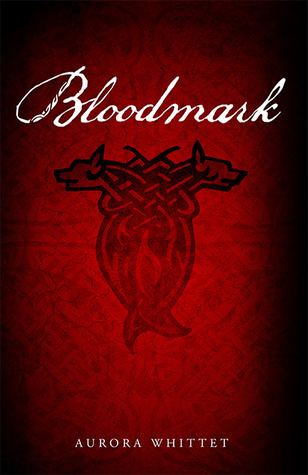
Bloodmark (Bloodmark Saga #1) by Aurora Whittet


On the first page, we learn that Ashling is part wolf, when she asks to take a one hour run instead of taking a three hour drive.
Just the thought of shifting to my wolf form made my pulse quicken with anticipation. It had been weeks since my bother, Mund, had visited and we could run free. I miss my red fur and four feet. 
We also learn right away that Ashling desparately wants to be part of a pack and has never left her home, the cliffs, and has never been around anyone except her mother and her brother(s).
I felt a hole inside myself where my pack should have been. I was certain Father was going to brand me with the Broro Bloodmark and accept me into the pack. I should have been branded as a baby, but he had refused. I still didn't know why. Without his Bloodmark on the back of my neck, I had no lineage and no family, no past, no future. 
Until the events in the book, she has only seen her father a handful of times and her other brothers even less. She grew up with only her mother and monthly visits from Mund.

In this story, werewolfs were created to protect humans. They were meant to watch over them.
Human blood smelled all the sweeter to us - a temptation we had to learn to overcome. Sometimes I wondered if it was all part of Old Mother's plan, the temptation was part of the lesson to love and protect something that you desperately desire to possess. I'm not sure how I feel about Ashling and Grey professing their love for each other after 2 or 3 days of meeting. I am getting pretty tired of the whole insta-love trend in YA books!
I like how Ashling related to the humans and took her responsibility to protect them seriously.
The nearby village was mostly Christians, but they still honored the old traditions. What they didn't realize was we lived them. We were the characters of their legends.
I was a little apprehensive about this book. Yes, I liked twilight when it first came out, but that is the extent of my werewolf/vampire reading...and (full-disclosure) I couldn't even make myself finish the last book...and I only saw the first movie...

I'm usually just not into the whole werewolf thing, but maybe it was the vampires put me off of them, because this book really surprised me! It started a little slow, and I remained doubtful, but when it started picking up, after the first couple of chapters, I was hooked!

I did have issues with a couple of things that YA authors can't seem to get away from.
  1. When the main female character is in mortal danger, and should be focusing on how to stay alive and save themselves, they are instead, thinking about kissing Mr. Main Character. 
  2. Also, there were a lot of little things that not only the love-struck heroine, but also, the older, wiser, more mature males overlooked that at this point (60% in), I believe will end up being big parts of the story (most likely its ending). Such obvious things could have been discussed and dealt with as they were revealed and it would have made the characters seem smarter and less invested in only their emotions. While I pretty much expected Ashling to overlook things like this, as almost all YA heroines do in their love-induced stupor, even Baron and overprotective bro, Mund, overlook things that ended up being super important to the story. 
I also do not like how careless she was at times, and when that carelessness inevitabely got her in trouble, she gave up way too easily.

Despite the fact that the book gives an explanation for the instalove in their case, I really wish YA books would steer away from it altogether.

However, I was impressed with this book and it definitely surpassed my expectations! I would definitely recommend it and can't wait to see how the story continues!

I received this book free from the publishers via NetGalley in exchange for an honest review.
 Link to my GoodReads review


Thursday, January 14, 2016

The Original PeachSkinSheets Giveaway

Sponsored By: PeachSkinSheets.com™

Hosted By: Heartbeats~ Soul Stains

Co-Hosted By:

Life in a House of Testosterone

Deliciously Savvy

Forever Dreamin'

Michigan Saving and More

The Homespun Chics

A big huge thank you to ALL the bloggers helping to promote The Original PeachSkinSheets Giveaway!

1 Lucky winners will each receive a set of the most fabulous sheets from PeachSkinSheets in their choice of color & size!

ARV up to $159

(See Review)PackageAndSwatchesAmazonCOMPRESSED

Thank you to our wonderful Sponsor for these prizes!

Now, Let's get to the Giveaway!!!!

Please take a minute to “like” us on facebook while you are visiting~ while it's not required, we sure do love it!

By following us on our social networks and by email/newsletter we are all able to get you the best giveaways; I hope you enjoy them!

Ending February 12th, 2016

PeachSkinSheets is responsible for fulfillment, shipping and all costs associated with this prizes.

All information collected is completely confidential and will only be used for contacting the winner and prize fulfillment purposes only.

Open to residents of the US, 18 and older. Ends at 11:59PM HST on 02/12/20156. At the conclusion of the giveaway, the winner will be randomly selected by Giveaway Tools (entries will be validated) and notified via email. The winner will have 48 hours to respond or a new winner will be chosen. This giveaway is NOT associated or endorsed by Facebook, Pinterest, YouTube,Twitter or any other social media. 1 Entrant per Household, if you have won a prize from this sponsor in the past 30 days you are not eligible to win.

If you have any questions or are a brand/company and would like to work with Heartbeats~ Soul Stains please contact us here


Tuesday, January 12, 2016

Nirvana by J.R. Stewart


I requested a previous version of Nirvana through NetGalley. Sometime after reading my review, which is posted on GoodReads only, as this was during my Pre-Blog era (PB), I received an email from the publisher asking if I would be interested in reading a revised copy of the book. They specified that there were changes made per reader reviews. So, since the previous version I read was pretty good, and I love when authors really listen to what their readers have to say, I accepted a new (and hopefully improved) copy of Nirvana.

HOLY CRAP! From the very first page, I could tell that the author had made significant changes to the book, and reading this version would likely be a much different experience than reading the first. This pleased me greatly, as I was unsure that I wanted to reread Nirvana again with only minor changes so soon.

I am much more fond of the playful way that Andrew approached Kenders in the previous version. I like that he had to work for it! From an early point in the book, I like the format of the previous version, as well. Here, all she says is, "I think he might have been a fan. He was actually kind of cute... My buddy Serge, who was visiting, watched us with a cautious eye, so I just traded numbers to hook up later.: while this may contribute to later changes, I still really liked the way she was standoff-ish at first, making him work for her attention.

Immediately after pointing out that change, I discover that Larissa's band becomes famous overnight, after Andrew teams up with her band and incites a protest. However, I still think that the banter from the previous way they met could be included seamlessly with this version. It made me like both of them immediately.

At some points in the previous version, the virtual reality concept was kind of confusing. This verious made it much clearer and more believable. Before, it seemed like the virtual reality was something people did alone to alleviate their depression from their sad lives.

From the get-go, Nirvana has a different feeling from the rationed-out hours (minutes) of fantasty to forget about the sad realities of life.

I like Kenders and Andrew's relationship better this go-round. I like how they balance each other out. It seemed like in the last version, we didn't learn a lot about their relationship. Instead, Kenders just whined a lot.
"Andrew and I are similar that way. We're music and science. It's creation and invention; writing a melody or an equation; conceiving new lyrics or a theory."
I don't recall the previous version giving Kenders' age, but I did not expect her to be 17! But school must be different, or Kenders is a genius and went to college super early.
"Way back in high school, (mom) already objected (to her music)..."
"She forgave me for dumping my scholarships, but I was 14..."
I know that this book has a YA feel, but from the first book, I really thought that Kenders was in her early 20's.

The basic premise of this version is the same, but the execution, overall, is much better! I think Nirvana was better represented in this revision.

Overall, well done on the revision! I enjoyed reading this version of the book more than I did the first time, and it was a much different experience, not at all like re-reading the same story.

I am definitely looking forward to seeing what happens in the next book in the Nirvana series!